
Beloved or Noise: Building Brands That Matter in 2026
In the age of AI-generated sameness, brands with a human touch will thrive.

Your brand is either beloved, or it’s noise.
Think about the last thing you bought, whether it was part of your grocery run, an ecommerce impulse buy, or a weekend trip to the mall. Did you choose the item because of its brand? Or did you just pick whatever was available?
For most purchases, we take the default option, whether it’s the grocery store in-house label or whatever Amazon’s algorithm shows us first. But for some purchases, we seek out specific brands. We choose them even when cheaper options exist. We recommend them without being asked.
These are the brands that we actually care about, the ones that actually mean something to us.
Today, generative AI makes it easier than ever to start a business, which is leading to a wave of commodity products and indistinguishable companies. AI can create a logo and help put up a website. It can identify competitors’ high-performing products and imitate them. It can create similar marketing campaigns and content. In short, it’s possible for an industry to be flooded with similar-sounding brands that sell nearly-identical products.
When customers do not have any way to differentiate between businesses and products, they take whatever product comes first. They will not become loyal customers to any business in the industry, because there’s nothing to be loyal to. Businesses fight for attention through paid placements, and when the ad spend stops, sales drop. The product effectively becomes a commodity.
The most effective way for leaders of small and mid-sized businesses to combat commodification and set themselves apart is to build a distinctive brand, one grounded in human creativity and conviction. The more you can bring your humanity into your brand, the more it will stand out from the competition, build trust with customers, and drive long-term value for your business.

Source: Amazon
Why Brand Matters More Than Ever For Small and Mid-Sized Businesses
A brand isn't just your logo, your colors, or your tag line. It's what people think and feel when they encounter your business. It's whether they remember you, trust you, and choose you every time. Purchase loyalty and word-of-mouth referrals strengthen your business long-term by reducing customer acquisition cost and enabling price increases.
In Branding That Means Business, Drs. Matt Johnson and Tessa Misiaszek argue that "brands need more magnetism than ever to draw people in… the brand is either beloved, or it's noise." The book was published right before ChatGPT took the AI world by storm, but we're seeing this play out in real time. The plethora of identical clothing businesses on Amazon with nonsensical names? That's noise.
So how do you build a beloved brand for your business? Start by building trust.
Trust transforms transactions into relationships. When customers trust your brand, they don't comparison-shop. They don't need the lowest price. They become advocates who recommend you without being asked.
And in the age of AI-generated sameness, trust comes from recognizably human touches. Customers can sense when something feels manufactured versus authentic. The more human your brand—through real decisions, real voices, real experiences—the more trustworthy it becomes. And trust drives loyalty, which drives sustainable business value.
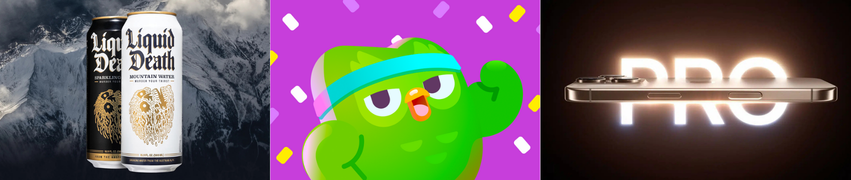
Photo credits: Eater, Duolingo, iLounge
Build a Beloved Brand on Strategic Conviction
I reached out to Dr. Matt Johnson, co-author of Branding That Means Business and a professor of psychology and marketing at Hult International Business School, to get his perspective on building brands in the AI age.
Dr. Johnson always starts with the fundamentals: what is your brand’s strategy? A brand with no strategy is doomed to fail. Defining the brand’s strategy means answering two seemingly simple questions: ”What do we do better, and who do we do it for?”
Answering these questions requires real human judgement.
Real brand strategy demands discovery and research that only humans can do. It means interviewing your customers, understanding your competitive landscape, and analyzing finances and operations. Beyond data analysis, it also requires synthesizing qualitative insights from observation and genuine conversation.
Brand strategy also requires making sacrifices. Will your brand be exclusive or for the masses? Will it be tailored to different geographies or consistent nationwide? These questions and more will come up when determining the brand strategy. Our judgement helps identify the best path forward for the business and for the brand.
Finally, brand strategy requires having conviction. Dr. Johnson points out the difference between being "market-driving" rather than "market-driven." He asks: "What are your independent convictions about what's good and beautiful and worthwhile in your industry? You're not merely automatons dangling from the springs of consumer sentiment."
Brand distinctiveness lives in your convictions, in your specific point of view on what matters in your industry. Leaning into what you think the algorithm will like will not make your brand stand out. Buyers are demanding a clear point of view on the market, and sometimes even on societal trends more broadly. According to Edelman, “84% of people globally report the need to share values with a brand to use it.” To share values with audiences, the brand must first define them.
Brand strategy isn’t about optimization. It’s about making choices about what the brand should and shouldn’t be, based on research, analysis, and conviction. AI optimizes for averages of its training material. It can’t make the tradeoffs that define what makes a brand different, so it ends up making all brands similar. Putting time, thought, and effort into brand strategy will develop something distinctive.

Photo credits: Britannica, Brand The Change, Artful Living Magazine
Your Personal Judgement Makes a Brand Beloved
Once you have your brand strategy, you need to bring it to life. This means making creative decisions: your business name, your logo, your visual identity, your messaging, your voice.
For leaders of small or mid-sized businesses, it can be tempting to save budget by turning to AI at this stage. AI can in fact “help,” if getting 50,000 logo variations or brand name ideas is helpful. Picking across this volume is challenging, if not impossible. (Our Mariner11 logo design clients sometimes find it difficult to choose between three options rooted in brand strategy and research.)
When doing logo design with AI, many will ask for more options and make infinite tweaks to a concept. Dr. Johnson warns: "A trust in one's personal convictions, a trust in one's personal judgment, that is incredibly important. When we go to these systems that will give us pretty easy responses too often, the muscles of personal judgement and personal taste tend to atrophy."
Your personal judgement and taste are what makes you you. Every time you defer to the algorithm instead of trusting your own taste, you lose a bit of what makes you distinctively you.
Your creative choices should reflect your strategic convictions. Your visual identity should express your point of view. Your messaging should sound like you, not like a slightly different version of everyone else in your industry.
AI certainly can play a role in creating the marketing outputs for a brand, and can do so with consistency that humans might not be able to. But it needs the right inputs. And those inputs—your brand identity, your core messages, your distinctive voice—have to come from human judgement. They need to come from creative choices that reflect judgement, articulate beliefs, and build trust rather than choices that optimize for the algorithm.
To build a brand that’s beloved, make it unmistakably yours. Make it one that couldn't be generated by a machine because it's too specific, too opinionated, too human.
Bringing a Beloved Brand to Life With Human Touches
You've built a brand grounded in human conviction. You've made creative choices that reflect your distinctive point of view. Now comes the critical part: demonstrating that humanity to your customers.
Remember: trust comes from recognizably human touches. Customers can sense when something feels manufactured. So how do you prove your brand is human, not AI-generated?
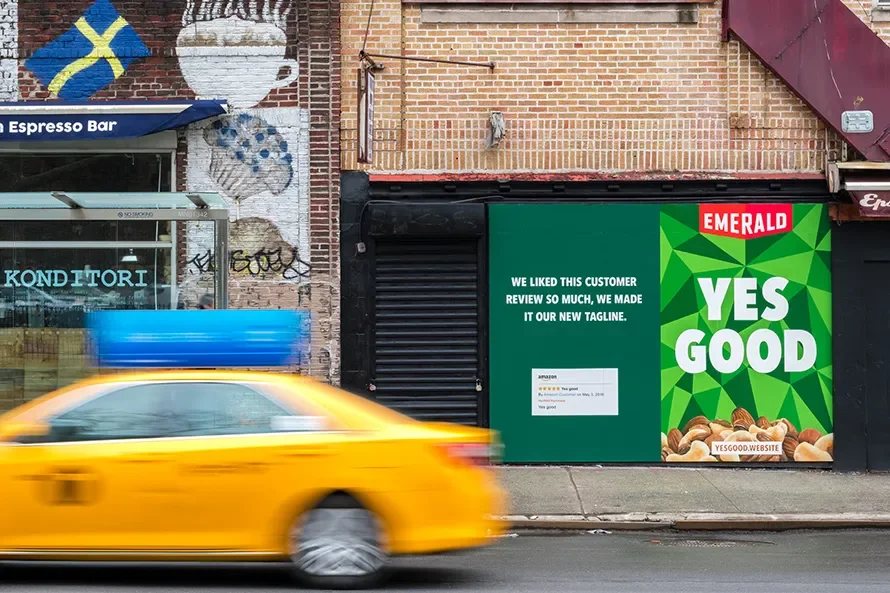
Photo credit: AdWeek
Use Real Human Language in Your Marketing
Pay attention to how people actually talk about your brand. Read your reviews carefully. Listen to conversations in Facebook groups, on Reddit, in online communities where customers gather. Notice the language patterns—the specific words and phrases they use when they describe what you do and why they chose you.
That language is marketing gold that AI cannot generate. It's authentic, it resonates because it comes from real customers, and it reflects how real people think about your value.
Take Emerald Nuts, which launched a 2017 campaign called “Yes Good,” the two words of an actual Amazon review. The simplicity and authenticity of real customer language created a memorable campaign that polished marketing copy never could.
While a brand’s core meaning and values should stay the same, the campaigns for a brand can evolve as you learn what actually matters to the people you serve. Social listening isn't just data collection. It's understanding how your brand lives in people's minds, in their own words.
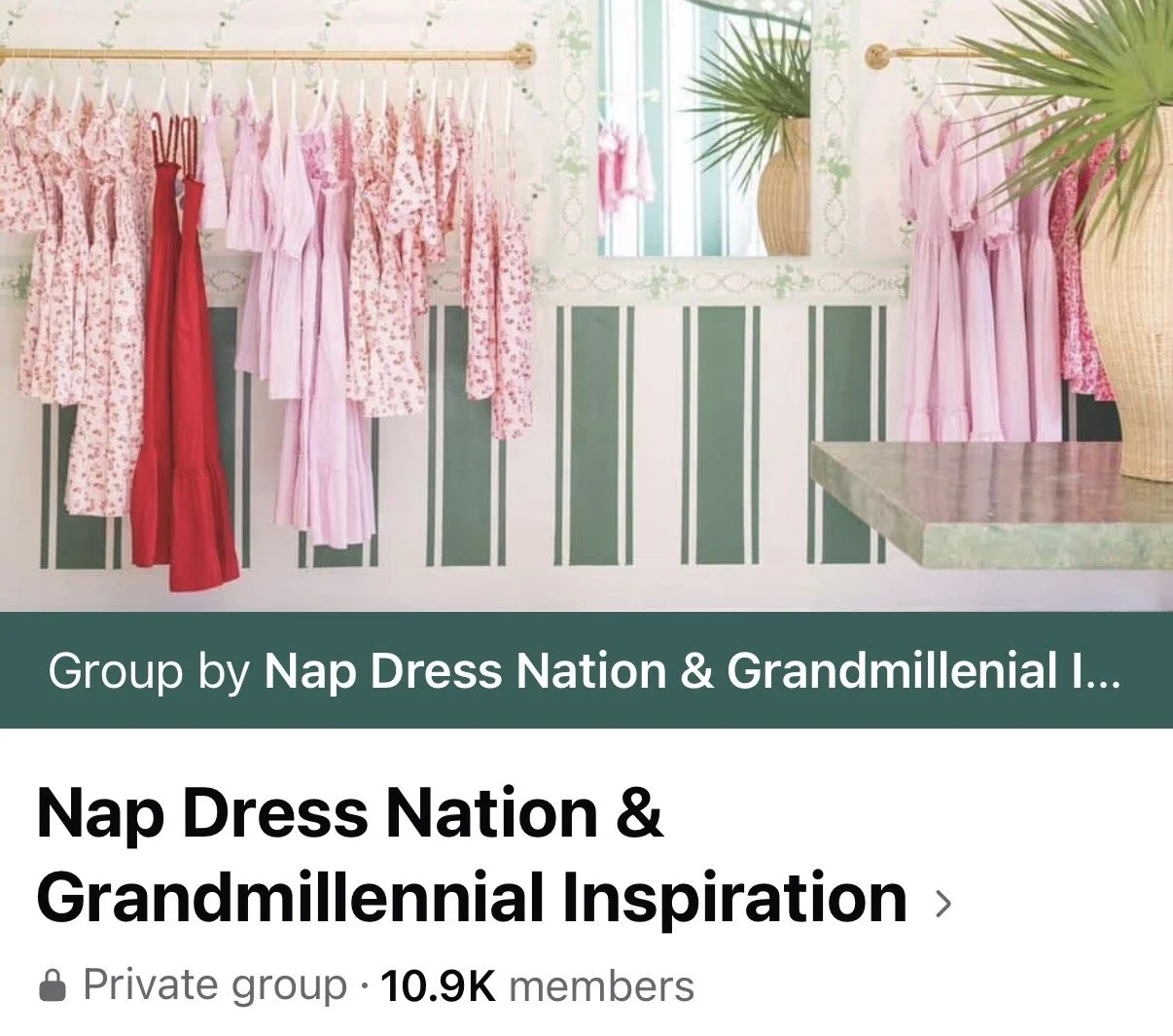
A private Facebook group discussing Hill House Home
Show Up Where Genuine Conversations Happen
People are retreating from public-facing social media because they’re tired of being sold to. They’re turning to private communities, invite-only groups, and forums to have direct conversations and to connect with others who share their interests or challenges.
If your business can show up authentically in those spaces—not to sell, but to genuinely participate and add value—you create trust that advertising can't buy.
Look at clothing brands like Tuckernuck or Hill House Home, where devoted customers create Facebook groups to discuss products, offer styling advice, or sell items. Smart brands listen to this feedback. They learn not just about fit and quality but about design direction and what customers actually want next. Some participate directly in these communities, answering questions and gathering insights that inform product development.
This human-to-human interaction can't be automated or AI-generated. And that's exactly what makes it valuable.

Daniel Boulud’s Blue Box Cafe at Tiffany’s; photo credit: Resy
Create Experiences in the Physical World
Take your business out of the digital realm and into the physical one. Dr. Johnson notes that while the digital world excels at helping us accomplish tasks, it has never been a great place for the kind of moment-to-moment experiences that make brands memorable.
As similar-looking brands flood the digital world, your business’s experiential dimension becomes more valuable. Physical experiences are more memorable, more tactile, more warm. They build the customer trust and authenticity that drive loyal customers in ways that digital interactions simply can't.
We worked with a restaurant client to bring their brand more visibly into their physical space. Bold colors reflected their identity. Their mission appeared where customers could see it: brand elements on coffee cups and at points of sale. The space didn't just serve food, it immersed customers in the brand's values and personality.
In a world of endless digital noise, physical presence is more valuable than ever. These moments can't be AI-generated.
The Challenge
Brands that stand out in 2026 will be unmistakably different. They’ll be quirky, opinionated, and specific. They’ll be distinctive in a way that makes customers remember them, choose them, and stay loyal to them.
That distinctiveness comes from human input: from your convictions, your creative choices, your team embodying your values.
Distinctive brands command premium pricing, create repeat customers, and generate the word-of-mouth momentum that reduces customer acquisition costs. Your business needs this to grow sustainably.
Don't let efficiency win over distinctiveness.
Your customers are looking for something different. Your team wants to rally behind something real. And your business needs a brand that's either beloved, or it's noise.
Will yours be beloved or noise? That choice starts today.
Ready to build a distinctively human brand? Schedule a discovery call to discuss your vision and how to bring it to life.